NFL Betting Strategy
NFL Bet of the Day: A Data-Driven Guide for UK Punters
 Available in US
Nine years ago I placed my first NFL spread bet from a sofa in Manchester, half-watching a Thursday night game I barely understood. The stake was small. The logic was non-existent. The result was predictable. I lost. What I gained, though, was an obsession: not with picking winners on gut feel, but with pulling apart the numbers behind every line a bookmaker posts.
That obsession eventually became my career. I spend my weeks modelling implied probabilities, comparing odds across licensed UK platforms, tracking injury reports from Tuesday practice windows, and filtering a full 16-game slate down to a single best play, the bet of the day.
Bet of the day: a single wager identified as the strongest value play on a given NFL slate, selected through systematic analysis rather than gut instinct or media hype. The goal is not to predict the most likely winner, but to find the widest gap between a bookmaker’s price and the true probability of an outcome.
This guide is written specifically for UK punters. The roughly 14.3 million NFL fans in Britain – 68% of them aged 18 to 44, per NFL International research – represent one of the fastest-growing betting audiences outside North America. Yet the vast majority of NFL betting content online is built for the American market, referencing sportsbooks you cannot access, laws that do not apply to you, and terminology that does not match what you see on your screen.
What follows is a complete framework for identifying, analysing and placing NFL bets from the UK. I will walk you through how a bet of the day is constructed from raw data, which types of wagers UK bookmakers actually offer, how to calculate expected value on any line, and how to protect your bankroll across a full 18-week regular season. Every stat is sourced, every concept is explained, and every example uses odds formats you will recognise.
Whether you are placing your tenth NFL bet or your thousandth, the principles here are the same: find value, size correctly, stay disciplined.
Table of Contents
- The Five Things This Guide Will Change About Your NFL Betting
- How an NFL Bet of the Day Is Selected
- The UK NFL Betting Landscape in Numbers
- Types of NFL Bets Available at UK Bookmakers
- Value Betting Fundamentals: Finding +EV in NFL Markets
- NFL Bet-of-the-Day Toolkit
- Seven Factors That Move NFL Lines
- A Weekly NFL Betting Workflow: Tuesday to Kickoff
- Bankroll Management Essentials for NFL Betting
- NFL Betting in the UK: Legal Framework and Tax Changes
- Five Costly Mistakes UK NFL Bettors Make
- Frequently Asked Questions
- Your Edge Is the Process, Not the Pick
The Five Things This Guide Will Change About Your NFL Betting
- A genuine “bet of the day” starts with implied probability and edge calculation, not tips, hunches or social media consensus.
- The UK’s 14.3 million NFL fans have access to spread, moneyline, totals, props and accumulator markets at licensed bookmakers, but tax changes (Remote Gaming Duty rising to 40%) are squeezing margins and promotions.
- Expected value (EV) is the only metric that matters long-term; this guide gives you the formula and a worked example you can apply to any line.
- Seven specific factors – from injury designations to weather thresholds, move NFL lines during the week, and knowing when they hit gives you a timing edge.
- Bankroll discipline, not prediction accuracy, separates profitable bettors from the 63% who admit to spending beyond their means.
How an NFL Bet of the Day Is Selected
Last December I spent three hours analysing a Week 15 divisional game only to watch the line I wanted evaporate by Thursday evening. The bet still had value at the new number (barely) but the experience reinforced something I tell every bettor I work with: selection is a process with a clock on it, not a flash of inspiration on Sunday morning.
A proper bet of the day begins days before kickoff. The selection process I use follows a repeatable sequence: model the game, identify the edge, verify the edge against market movement, then commit or walk away. No step is optional.
Worked example: selecting a bet of the day
Step 1 – Model the matchup. I pull offensive and defensive efficiency ratings, recent form over the last four games, and situational data (home/away splits, divisional record, rest days). These inputs generate a projected point total and a win probability for each side.
Step 2 – Convert bookmaker odds to implied probability. Suppose a bookmaker prices one side at 2.10 in decimal odds. The implied probability is 1 / 2.10 = 47.6%. My model gives that side a 53% chance of covering. The gap, 5.4 percentage points, is the edge.
Step 3 – Filter by edge threshold. I require a minimum 3% edge before any bet enters consideration. Anything below that is noise. Above 5% is strong. The 5.4% edge in this example qualifies.
Step 4 – Check for confirmation or contradiction. Has the line moved toward my side since opening (suggesting sharp agreement) or away from it (suggesting I may be wrong)? Are there injury updates that change my inputs? If the edge survives, it becomes the bet of the day.
Implied probability: the chance of an outcome occurring as suggested by the bookmaker’s odds, before accounting for margin. Calculated as 1 / decimal odds.
Edge: the difference between your estimated true probability and the bookmaker’s implied probability. A positive edge means the odds are in your favour over the long run.
Shaun Stack, a senior NFL analyst, describes his own version of this process: “I try to account for as many factors as possible, from usage rates and schemes to weather and a coach’s job security. Some schemes match up better against others, while some teams and players are at a distinct advantage in cold or rainy weather.” That layered approach, quantitative inputs refined by contextual factors – is what separates systematic selection from guesswork.
The critical discipline is rejection. On a typical NFL Sunday, 77% of bettors plan to wager on at least one game, per Optimove research. Most bet multiple games. I often bet one. Some weeks, when the edges are thin, I bet none. The bet of the day is not an obligation to fill. It is a filter designed to surface only the strongest play on the board.
The UK NFL Betting Landscape in Numbers
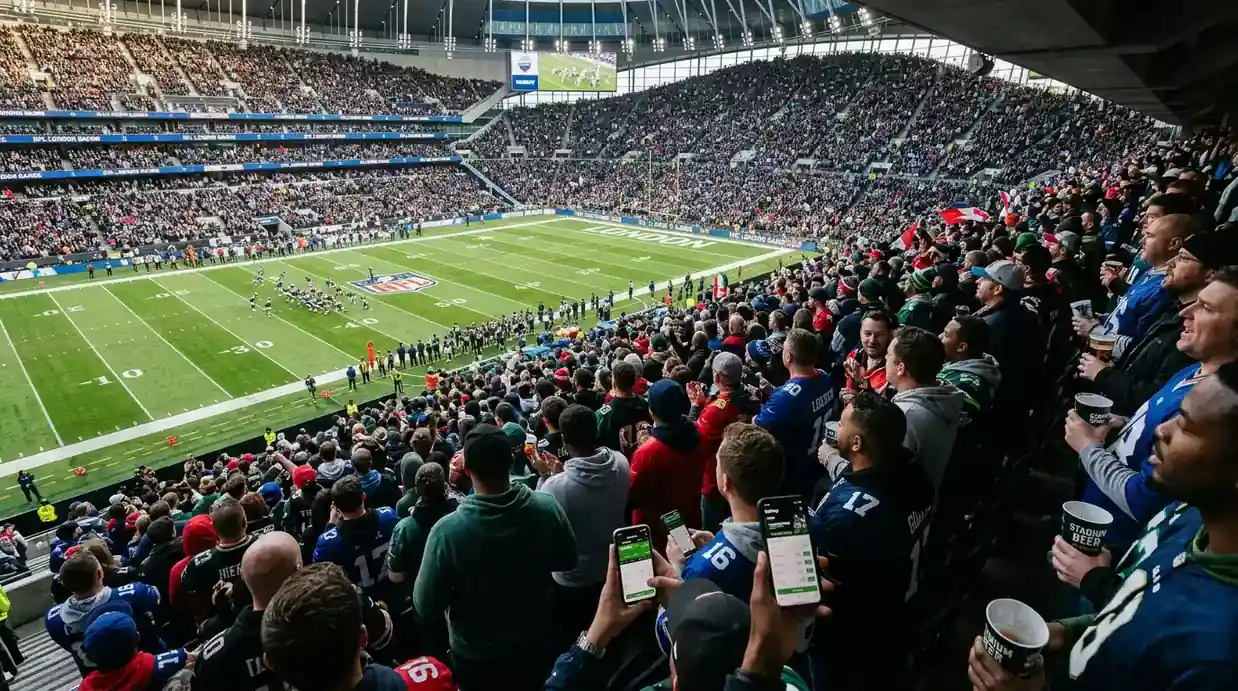
I attended the Jaguars-Falcons game at Wembley in the 2025 season – one of a record seven international regular-season fixtures, three in London. The crowd of roughly 85,000 was not a novelty act. These were fans who knew offensive formations, debated play-calling, and had active bet slips on their phones before the opening drive. London has become an NFL city, and the betting market reflects it.
14.3 million
Estimated NFL fans in the UK, with approximately 4 million classified as “avid” followers, per official NFL research.
68%
Share of UK NFL fans aged 18-44 – the most active online betting demographic per NFL International data.
16.8 billion pounds
Total Gross Gambling Yield for the UK industry in the year to March 2025, a 7.3% annual rise, per the UK Gambling Commission.
10%
Share of UK adults who participate in online sports betting, per UKGC survey data from 2025.
Those numbers tell a clear story. The UK already has a massive, young, digitally engaged NFL audience – and they are betting. The broader gambling market generated 16.8 billion pounds in Gross Gambling Yield in the year to March 2025, with 10% of UK adults actively placing sports bets online. For context, 47% of all UK adults participate in some form of gambling, meaning sports bettors represent a committed subset.
The gender split remains stark: 15% of men bet on sport compared to just 4% of women, per UKGC data from early 2025. But among NFL-specific audiences, the age profile is what matters most for market dynamics. A fan base where more than two-thirds sit in the 18-44 bracket means mobile-first behaviour, comfort with in-play markets and an expectation of real-time data. All of this shapes how UK bookmakers structure their NFL offerings.
When Tottenham Hotspur Stadium hosted its first NFL games in 2019, tickets were oversubscribed 12 times over and sold out within 45 minutes, roughly 750,000 unsuccessful purchase attempts for a single fixture, per official NFL figures. That demand has not cooled; the 2025 London series filled every allocated seat across all three games.
Smart Betting Guide research found that UK search interest in NFL extends well beyond London. “Cities such as Croydon, Newcastle, and Manchester are showing disproportionate search activity levels, signaling curiosity and a growing, digitally engaged fan culture,” according to the firm’s analysis. The UK accounts for approximately 3% of global NFL search traffic (more than Germany) with the Kansas City Chiefs the most-searched team at 9.5% of UK queries in October 2025, per Hyperset Group data.
What all of this means for you as a bettor: the market is deep enough that UK bookmakers invest in NFL coverage but niche enough that pricing inefficiencies still exist, particularly in player prop and totals markets where liquidity is thinner than on Premier League football. That gap is where value lives.
Types of NFL Bets Available at UK Bookmakers
The first time I opened an NFL betting page at a UK bookmaker, I counted over 200 individual markets for a single game. For someone used to backing a football team to win at home, that is sensory overload. But every one of those 200 markets falls into a handful of categories, and once you understand them, the complexity dissolves.
Optimove’s research on bettor preferences confirms what I see in practice: among active NFL wagerers, 61% regularly bet point spreads, 52% use moneylines, and 47% play over/under totals. Those three markets form the foundation. Everything else, from props to accumulators to futures, builds on top of them.
Point spread: a handicap applied to the favourite to level the contest. If a team is listed at -3.5, they must win by 4 or more points for a spread bet to pay out. The underdog at +3.5 covers if they lose by 3 or fewer, or win outright.
The spread is the heartbeat of NFL betting. It exists because most NFL games are competitive enough that a simple win/lose market produces lopsided odds. By adding a handicap, bookmakers create a roughly even-money proposition on both sides. For a deep dive into how spreads function, including the critical role of key numbers like 3 and 7, see my full breakdown of NFL spread picks and ATS trends.
Totals (over/under): a bet on whether the combined score of both teams will finish above or below a number set by the bookmaker. A total of 44.5 means you bet Over (45+ combined points) or Under (44 or fewer).
Totals strip team allegiance from the equation entirely. You are betting on the nature of the game, whether a shootout or a defensive grind, rather than who wins it. Pace of play, offensive efficiency, defensive red-zone percentage and weather conditions are the core inputs. I find totals particularly useful in divisional matchups late in the season, where familiarity between teams tends to suppress scoring.
Moneyline: a straight bet on which team wins the game, with no spread involved. The favourite carries shorter odds; the underdog carries longer odds.
Example: spread vs moneyline payout
| Bet type | Selection | Odds (decimal) | Stake | Payout |
|---|---|---|---|---|
| Spread (-3.5) | Team A | 1.91 | 10 pounds | 19.10 pounds |
| Moneyline | Team A | 1.45 | 10 pounds | 14.50 pounds |
| Moneyline | Team B (underdog) | 2.90 | 10 pounds | 29.00 pounds |
Player props: bets on individual player performance: passing yards, rushing yards, receptions, touchdown scorer and more. These markets let you isolate matchups rather than predicting an entire game outcome.
Player props have exploded in popularity. Same-game parlays – which bundle multiple props from a single fixture – accounted for more than 25% of total handle on Super Bowl LX, per SportsEpreneur analysis. For UK bettors, props offer a way to leverage deep knowledge of specific players without needing to predict the game result. I cover the analytical methods for NFL player props tips in a dedicated guide.
Accumulator (acca): a multi-leg bet combining selections from different games into a single wager. All legs must win for the bet to pay out. Accas multiply the odds of each leg together, producing larger potential returns from small stakes.
| Feature | Point spread | Moneyline |
|---|---|---|
| What you bet on | Margin of victory relative to the handicap | Outright winner, no handicap |
| Typical odds range | 1.85 to 1.95 (close to even) | Varies widely (1.10 to 5.00+) |
| Best for | Tight games where you have a view on margin | Games where you expect an upset or a comfortable win |
| Edge for beginners | Easier to find value – the market is most efficient | Simpler concept, but harder to find mispriced lines |
Accumulators are arguably the most UK-specific format in NFL betting. The culture of building weekend accas is embedded in British sport, and bookmakers have responded with NFL-specific bet builder tools that let you combine result, totals and prop legs from a single match. My guide to NFL accumulator tips covers leg selection, correlation traps and which promotional offers are worth your attention.
Value Betting Fundamentals: Finding +EV in NFL Markets
Here is the uncomfortable truth about NFL betting: you can pick winners at a 55% clip and still lose money if you are consistently taking bad prices. I learned this the hard way during my second full season, when a solid run of correct predictions produced a net loss because I was betting into lines that offered no edge. Value, the relationship between what you are paid and what you should be paid, matters over a full season.
The American legal sports betting market processed 30 billion dollars in NFL handle during the 2025 season alone, an 8.5% increase on the prior year, per the American Gaming Association. That staggering volume means the market is broadly efficient, but “broadly” is not “perfectly.” Edges exist in pockets: early-week lines before injury news, niche prop markets with less liquidity, and totals in weather-affected games where bookmakers rely on generic models.
The expected value formula
EV = (Probability of winning x Net payout if you win) – (Probability of losing x Stake lost if you lose)
Suppose you estimate a 55% probability on a selection priced at 2.05.
EV = (0.55 x 1.05) – (0.45 x 1.00) = 0.5775 – 0.45 = +0.1275
For every pound staked, you expect to gain 12.75 pence over the long run. This is a positive expected value (+EV) bet.
Worked example: applying EV to a real line
A bookmaker offers an NFL team at decimal odds of 1.90 to cover the spread. Implied probability: 1 / 1.90 = 52.6%.
Your model projects a 57% chance of covering. Edge: 57% – 52.6% = 4.4 percentage points.
EV per pound = (0.57 x 0.90) – (0.43 x 1.00) = 0.513 – 0.43 = +0.083.
Over 100 bets at one pound each, you would expect to profit roughly 8.30 pounds. The edge is modest but real, and it compounds across hundreds of selections per season.
Value Toolkit
NFL Bet-of-the-Day Toolkit
Find the gap between a bookmaker’s price and the true probability — calculate your edge, your EV, and whether the play clears the bar.
Enter the bookmaker’s price and your own model’s true probability. The tool converts the odds to an implied chance, finds the gap (your edge), and prices the long-run EV.
A +EV bet still loses sometimes — the edge only reveals itself over hundreds of wagers. If you can’t say why the price is wrong, you have a guess, not a bet.
Every price carries a break-even win rate — the minimum you must hit just to clear the bookmaker’s margin. Know it before you bet, not after.
A 50% record at 1.91 is a loss. Enter your tracked results to see whether you’re beating the margin or just feeling like it.
A bet of the day emerges when an edge and multiple factors converge. Set your edge, then mark which of the seven line-movers favour your side.
The scorecard is a filter, not an obligation. Some weeks the strongest play still isn’t strong enough — and no bet is the correct bet.
A positive expected value does not guarantee a winning bet. EV is a long-term metric. A +EV bet can lose; a -EV bet can win. The edge reveals itself over hundreds of wagers, not one Sunday. If you find yourself adjusting your process after a single bad result, you are reacting to variance, not information.
Bill Miller, president of the American Gaming Association, framed the broader market growth in 2025 by noting that “legal sports betting enhances the fun and friendly competition that make NFL games and traditions even more special.” That growth is good news for value seekers: more liquidity means sharper opening lines, but it also means bookmakers compete on price. That price competition creates discrepancies you can exploit by comparing across platforms.
For a deeper exploration of closing line value, odds comparison methodology and systematic bet tracking, I have written a complete NFL value bets strategy guide. What matters here is the principle: every bet you place should have a calculated edge. If you cannot articulate why the price is wrong, you do not have a bet. You have a guess.
Seven Factors That Move NFL Lines
A line opens on Sunday evening for the following week’s games. By kickoff the next Sunday, it might have shifted by two full points or more. Understanding why (and when) those shifts happen gives you a structural advantage over bettors who only look at the number in front of them at the moment they decide to bet.
Over nine years of tracking NFL markets, I have identified seven factors that consistently move lines. Not all of them matter equally in every game, but all of them matter at some point during every season.
The seven factors to assess before placing any NFL bet
- Injury reports. The NFL mandates Wednesday-Thursday-Friday practice participation reports. A starting quarterback moving from “limited” to “did not participate” can shift a spread by 3+ points overnight. Timing is everything: the final injury report drops on Friday afternoon US time (late Friday evening UK time), and lines adjust within minutes.
- Weather conditions. Wind above 15 mph suppresses the passing game, pushing totals down. Rain, snow and sub-zero temperatures have a documented effect on scoring. Unders in divisional matchups carry a 57% win rate historically, and that edge strengthens in cold-weather games from Week 13 onward, per Pickswise analysis.
- Sharp money and reverse line movement. When the line moves against the side receiving the majority of public bets, professional money is likely responsible. Tracking these “steam moves” reveals where informed capital sits. I watch for splits where 70%+ of tickets are on one side but the line moves the other way.
- Scheduling and rest. A team on a short week (Thursday Night Football) or coming off a Monday night game travels with a physiological disadvantage. Bye-week rest matters in the opposite direction: teams returning from a bye historically perform better against the spread.
- Divisional familiarity. Teams in the same division play each other twice per season. The second meeting, typically later in the year, produces tighter, lower-scoring games as coaches adjust schemes. This familiarity compresses spreads and favours under bets.
- Public perception and media narratives. A team that wins big on Sunday Night Football gets overvalued by the public the following week. Primetime bias inflates lines. I look for spots where a team’s national profile exceeds their on-field efficiency metrics.
- Same-game parlay and prop market liquidity. Same-game parlays made up more than 25% of Super Bowl LX handle, and player props accounted for up to 60% of activity on some platforms, per SportsEpreneur data. Heavy prop action can pull the main line, particularly on star players whose over/under totals attract disproportionate volume.
NFL injury designations explained: “Out” means the player will not play. “Doubtful” means they are unlikely to play (roughly a 25% chance). “Questionable” is the grey zone – the player has about a 50/50 chance. The shift from “questionable” to “out” on a Saturday afternoon is the single most common cause of late line movement in NFL markets.
That is the right frame for any serious bettor. No single factor determines a line. The bet of the day emerges when multiple factors converge – and the market has not yet caught up.
A Weekly NFL Betting Workflow: Tuesday to Kickoff
My phone alarm goes off at 7:30 on Tuesday mornings during the NFL season. Not for work, not for the gym – for opening lines. By the time most UK bettors start thinking about Sunday’s games on Friday afternoon, I have already built a preliminary model, identified two or three candidate bets, and set price alerts on the lines I want.
That head start is not about being clever. It is about structure. A disciplined weekly workflow removes emotion from the process and forces you to engage with data before narratives take hold. Here is how my week unfolds.
Weekly timeline: from opening lines to kickoff
Tuesday (lines open). I pull the opening spreads, totals and moneylines from three UK-licensed platforms. I run each game through my model, noting where my projected line diverges from the market by 2+ points. These become my watchlist games – typically four or five per week.
Wednesday (first injury reports). NFL teams release their first practice participation reports. I cross-reference my watchlist games against the injury data. A key absence that the market has not fully priced in is an immediate edge candidate. I also check early line movement: has the market already shifted toward my position, or am I still getting the opening price?
Thursday (refinement). Second injury reports arrive. I update my models with any new information. If a watchlist game’s edge has narrowed below my 3% threshold due to line movement, I remove it. The Thursday night game, if it is on my list, gets locked in by early evening UK time.
Friday (final reports and decision). The final injury designations are published. This is the sharpest informational window of the week – the gap between the report dropping and the market adjusting is measured in minutes, not hours. I make my final selections, typically narrowing to one or two bets. If I have strong conviction, I place the wager Friday evening. If the line is moving in my favour, I wait.
Saturday/Sunday (execution). Remaining bets are placed by Sunday morning UK time. I do not add new selections on game day – the research window is closed. I watch the games, record the outcomes, and begin preliminary notes for the following week.
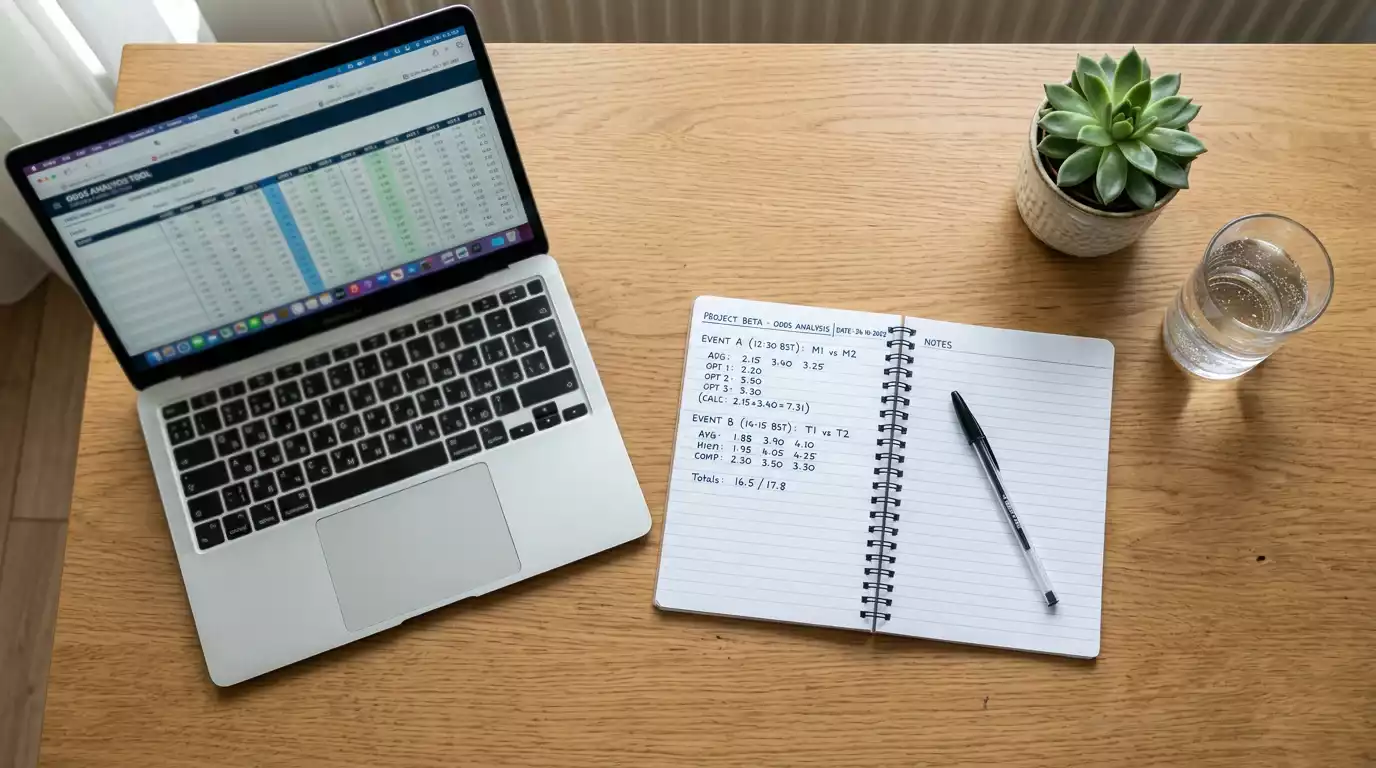
76% of NFL bettors place their wagers through mobile platforms or online, per Optimove research, and 80% use two or more sites each week. That multi-platform behaviour is not just convenience. It is edge. Comparing odds across licensed UK bookmakers is the simplest way to extract an extra fraction of value on every bet. A difference of 1.90 versus 1.95 on the same selection does not sound dramatic, but compounded over 100 bets per season, it is the difference between a marginal loss and a marginal profit.
One trend worth noting: live betting participation dropped from 37% to 25% between the 2024 and 2025 seasons, per the same Optimove data. Pre-game bets are regaining ground. I view this as healthy – live betting is reactive by nature. The workflow I describe above is designed to make pre-game decisions from a position of informational strength, not emotional reaction.
For detailed analysis of how to select the week’s top plays from this filtered shortlist, see my guide to identifying NFL best bets each week.
A structured workflow produces better selections – but even the best selections destroy a bankroll if staking is reckless.
Bankroll Management Essentials for NFL Betting
63% of NFL bettors admit to spending more than they could afford, per Optimove research. That is not a statistic about problem gambling – it is a statistic about missing plans. Every one of those bettors presumably intended to stay within budget. What they lacked was a system to enforce it.
Do
- Set a dedicated NFL bankroll at the start of the season – money you can lose entirely without affecting your life.
- Stake a fixed percentage per bet (1-3% of total bankroll) regardless of confidence level.
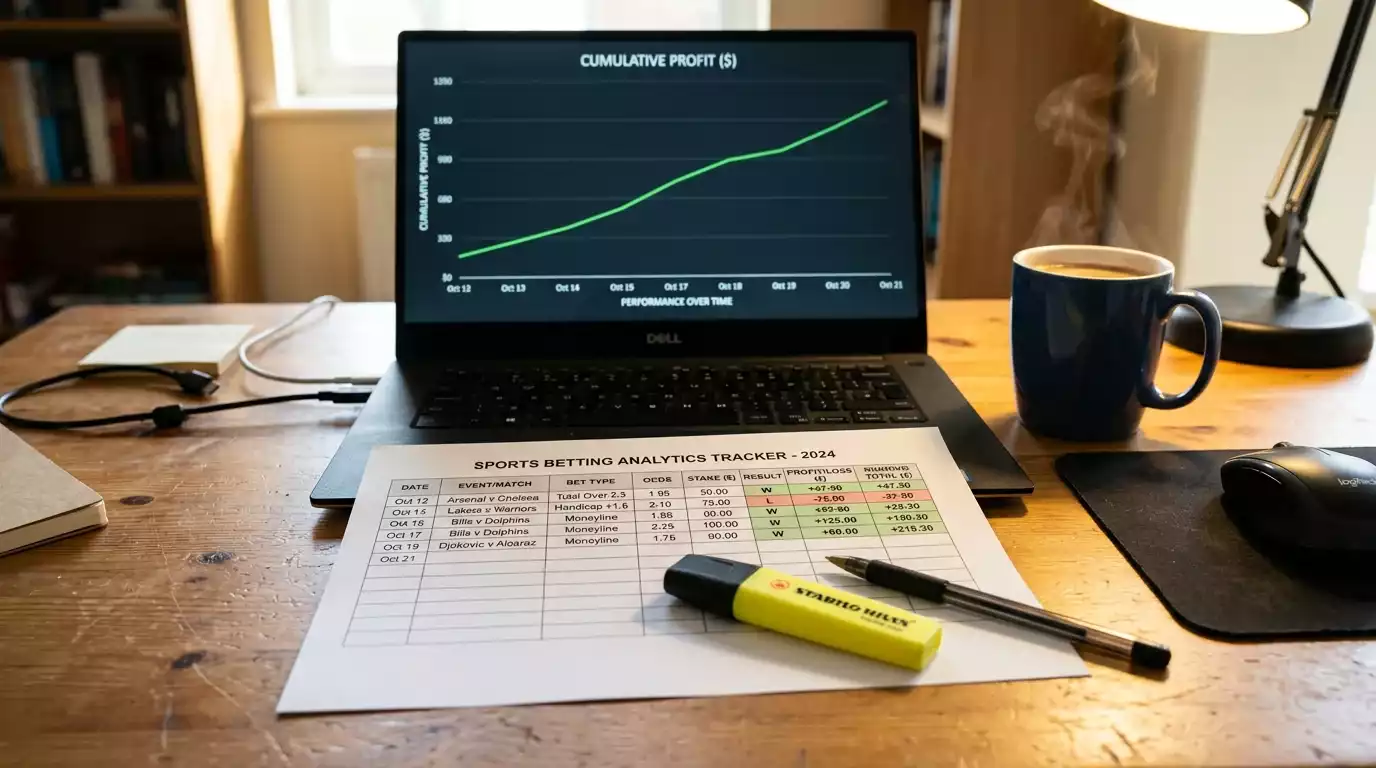
- Track every bet in a spreadsheet: date, selection, odds, stake, result, running profit/loss.
- Review your record every four weeks and adjust stake size only if your bankroll has grown or shrunk significantly.
Don’t
- Chase losses by doubling your next stake after a bad week.
- Increase stakes on “certainties” – no such thing exists in a sport decided by inches.
- Fund bets from your current account rather than a ring-fenced bankroll.
- Ignore your own data – if your record shows a consistent leak in a specific market, stop betting that market.
Flat staking – betting the same amount on every selection – is the simplest approach and the one I recommend for anyone with fewer than two full seasons of tracked results. It removes the temptation to over-weight “big plays” and keeps variance manageable. More advanced bettors can explore fractional Kelly Criterion staking, which adjusts bet size in proportion to edge size, but Kelly requires accurate probability estimates and an honest assessment of your own model’s reliability.
Bill Miller of the American Gaming Association noted that record Super Bowl LX wagering – a projected 1.76 billion dollars in legal bets – reflected fans “having fun while supporting a safe and responsible market.” Fun and responsibility are not contradictory, but they require structure. A bankroll plan is that structure.
The NFL regular season spans 18 weeks. That is roughly 80 to 120 betting opportunities if you follow a selective workflow. A 3% losing streak across ten consecutive bets at flat 2% stakes costs you 20% of your bankroll – recoverable over the remaining season. The same streak at 10% stakes costs you 100%. Stake sizing is not glamorous, but it is the single factor most likely to determine whether you are still betting in January.
NFL Betting in the UK: Legal Framework and Tax Changes
Unlike the patchwork of state-by-state legalisation in the United States, betting on the NFL in the UK is straightforward: it is legal, regulated, and has been for decades. Any bookmaker holding a licence from the UK Gambling Commission can offer NFL markets, and you face no tax liability on your winnings. The tax obligation falls on the operator, not the punter.
But that operator-side tax picture has changed dramatically – and the ripple effects reach your odds screen.
Remote Gaming Duty: 21% to 40%
The single largest increase in UK gambling tax history, effective 1 April 2026. HM Treasury projects this will raise more than 1 billion pounds annually.
General Betting Duty: 15% to 25%
A new rate for remote betting operators, taking effect from April 2027. Horse racing in the UK is excluded from the increase.
HM Treasury justified the increases as part of “our ambition to create a fair, modern and sustainable tax system,” with the revenue earmarked to “support the public finances.” The political logic is clear. But the practical consequences for NFL bettors are real.
When operators face higher duty bills, the cost gets passed through in three ways: wider margins on odds (you get slightly worse prices), reduced promotional offers (fewer free bets and boosts), and in some cases, market withdrawal from lower-volume sports. NFL is not Premier League football. It generates less handle for UK bookmakers, so it sits in a vulnerable spot.
UKGC licence check: Before placing any NFL bet, verify that your bookmaker holds a current licence from the UK Gambling Commission. You can search the public register on the UKGC website. An unlicensed operator offers no consumer protection, no dispute resolution, and no guarantee that your funds are segregated.
Kennedys Law, analysing the impact of the duty changes, observed that “both scale and smaller players” were flagging “material impacts on earnings, job cuts and marketing and sponsorship reductions in a bid to offset the impacts of the increases.” For bettors, the actionable takeaway is simple: compare odds more aggressively than ever. As margins widen unevenly across operators, the gap between best and worst available price on a given NFL line will grow – and that gap is pure, capturable value.
Total UK gambling tax receipts are forecast to reach 5 billion pounds in 2026/27, a 24.8% year-on-year increase, per House of Commons Library analysis. The industry is being taxed more heavily, and you will feel it in the prices you are offered. The best defence is discipline: shop lines, track closing prices, and never accept the first number you see.
Five Costly Mistakes UK NFL Bettors Make
I have made every one of these mistakes myself. Some of them cost me money; all of them cost me time. The difference between a losing season and a profitable one is often not about finding better picks – it is about eliminating the errors that erode your edge before it has a chance to compound.
The mistake
- Betting every game on the slate. A typical NFL Sunday features 13 to 16 games. Betting all of them is not diversification – it is dilution. You are guaranteed to include games where you have no edge, and those bets drag your overall return toward the bookmaker’s margin.
- Ignoring the vig when assessing results. A 50% win rate at average odds of 1.91 produces a net loss of roughly 4.5%. You need to win approximately 52.4% just to break even on standard spreads. Bettors who celebrate a “winning week” without accounting for the margin are fooling themselves with incomplete maths.
- Treating accumulators as lottery tickets. A six-leg acca at combined odds of 30.00 has an implied probability of 3.3%. The entertainment value is real, but if accas represent more than 10-15% of your total action, you are systematically overpaying for variance.
- Betting based on UK broadcast schedules. Sky Sports shows selected games – typically the most high-profile matchups. These games attract heavier public betting, which tightens the market and reduces edges. Some of the best value sits in the early-window games that receive minimal UK media coverage.
- Neglecting to track results honestly. As I noted in the bankroll section, the majority of NFL bettors overspend – and the root cause is often a lack of visibility into cumulative performance. Without a tracked record, you cannot identify which markets, bet types or situations are profitable for you – and which are not.
The fix
- Cap your bets at 1-3 per week. If your process does not surface a clear edge, do not bet. The NFL season is long enough that patience pays.
- Calculate break-even win rate for every odds level. At 1.91, you need 52.4%. At 2.00, you need 50%. At 2.50, you need 40%. Know these numbers before you place the bet, not after.
- Allocate a fixed acca budget. Treat it as entertainment spend, separate from your analytical bankroll. If it wins, great. If not, it does not compromise your core strategy.
- Seek out low-profile games. Early-window matchups, non-divisional games and teams with smaller UK followings often carry softer lines.
- Use a spreadsheet from day one. Record date, game, market, selection, odds, stake, result, profit/loss. Review monthly. This is non-negotiable.
None of these fixes require advanced modelling or expensive data subscriptions. They require honesty with yourself and consistency in execution. The 37% of NFL bettors who stay within their means, per the same Optimove research, are not luckier than the rest – they are more structured.
Frequently Asked Questions
What is an NFL bet of the day and how is it selected?
A bet of the day is a single wager identified as the strongest value play on a given NFL slate. It is selected through a systematic process: modelling the matchup, calculating the implied probability from the bookmaker’s odds, comparing that to your own estimated probability, and only committing when the edge exceeds a minimum threshold – typically 3% or higher. The goal is not to pick the most likely winner, but to find the price that offers the greatest long-term return relative to risk.
How do point spreads work in NFL betting?
A point spread is a handicap applied to the favoured team to create a balanced betting market. If a team is listed at -6.5, they must win by 7 or more points for a spread bet on them to succeed. The opposing team at +6.5 covers if they lose by 6 or fewer points, or win outright. Spreads are the most popular NFL market among bettors, with 61% of regular NFL wagerers using them, per Optimove data. The key numbers to understand are 3 and 7, which correspond to the most common margins of victory in the NFL.
What is value betting in the NFL and how do you find +EV bets?
Value betting means placing wagers where the odds offered by the bookmaker underestimate the true probability of the outcome. A positive expected value (+EV) bet is one where your estimated probability exceeds the bookmaker’s implied probability. To find them, you need a method of estimating true probability – whether through your own model, market consensus analysis, or a hybrid approach – and then compare that estimate against the available odds across multiple platforms. The formula is straightforward: EV = (your probability x net payout) minus (probability of loss x stake).
Is it legal to bet on the NFL in the UK?
Yes. NFL betting is fully legal in the United Kingdom and has been for decades. Any bookmaker licensed by the UK Gambling Commission can offer NFL markets. Unlike the United States, where sports betting is regulated state by state, the UK operates under a single national framework. You pay no tax on winnings – the tax obligation sits with the operator. Always verify that your bookmaker holds a current UKGC licence before depositing funds.
What types of NFL bets are available at UK bookmakers?
UK-licensed bookmakers typically offer point spreads (handicaps), moneylines (match winner), totals (over/under on combined score), player props (individual performance markets such as passing yards or touchdown scorer), accumulators (multi-leg bets combining selections across games), same-game parlays (multiple selections from a single fixture), and futures (long-term markets like Super Bowl winner or division champions). Market depth varies by operator – larger platforms tend to offer a wider range of prop and in-play options.
How do injury reports affect NFL betting lines?
NFL teams are required to publish practice participation reports on Wednesday, Thursday and Friday during the regular season. Players are designated as full participant, limited, or did not participate, and given status labels of questionable, doubtful or out. A starting quarterback ruled out can shift a spread by 3 or more points. The most impactful window is Friday afternoon US time (late Friday evening UK time), when final designations are published. Lines adjust within minutes of significant injury news, making timing critical for bettors seeking to capture value before the market moves.
What is the difference between sharp money and public money in NFL betting?
Public money refers to the aggregate volume of bets placed by recreational bettors, often influenced by media coverage, team popularity and recent results. Sharp money comes from professional or syndicate bettors who wager large amounts based on proprietary models and analysis. The key signal is reverse line movement: when the majority of bets (by ticket count) favour one side, but the line moves in the opposite direction, it typically indicates sharp money on the other side. UK bettors can access public betting split data through several free American analytics platforms, though the data reflects US-market activity rather than UK-specific action.
Your Edge Is the Process, Not the Pick
I started this guide with a confession about a losing bet placed from a Manchester sofa nine years ago. The difference between that bet and the ones I place now is not that I have become better at predicting NFL outcomes (though I have). The difference is that I no longer try to predict outcomes at all. I try to identify prices that are wrong.
That shift in framing changes everything. It means some weeks you do not bet. It means you walk away from games you desperately want to watch because the line offers no edge. It means you track, review and adjust your approach with the same rigour you would apply to any serious analytical project. The UK’s NFL fan base is growing, bookmaker competition is intensifying, and market depth is expanding – conditions that create opportunity for the disciplined minority who treat this as a craft rather than a gamble.
Build your workflow. Calculate your edges. Protect your bankroll. The numbers, over time, take care of the rest.
A genuine NFL bet of the day is not a tip but the output of a repeatable analytical process. Define your edge threshold, compare odds across platforms, respect your bankroll limits, and let variance play out across the full season. The UK market offers deep NFL coverage and regulatory protection; your job is to exploit pricing gaps with discipline and patience.
Created by the ”nfl bet of the day” editorial team.